Making Rigorous Learning Reachable for All Learners
- Azia Knox
- Sep 14, 2025
- 3 min read

During the course, I researched how multimodal and culturally responsive teaching can make classrooms become spaces where every student can learn difficult material. Technology is more than simply a tool; it's a bridge that links different types of learners to fairness, involvement, and access. In this blog, I'll talk about what I discovered from my study, provide both quantitative and qualitative data, and suggest ways that teachers might improve their teaching and learning.
Key Research Findings
Quantitative insights
Teachers said that multimodal aids, such visuals, music, and tech tools, made students more interested in learning, particularly ELLs and children with IEPs.
Most of them employed multimodal tactics on a regular basis and were sure they could choose the correct tools if they had enough professional development.
Time, not enough training, and not always having access to resources were some of the barriers.
Qualitative insights
Teacher interviews identified themes of student voice, identity, familial ties, and restorative practices as significant methods to enhance the relevance of learning.
Technology-enhanced culturally responsive education was beneficial. For instance:
1. Interactive read-alouds with bilingual slides.
2. Edpuzzle videos with pause-questions and captions.
3. Choice boards allowing students to respond with video, drawing, or audio.
4. Flip video reflections supported with multilingual sentence stems.

Reflection
One of the most significant things I learnt from this process was how crucial it is for everything to be in sync. This means that the issue, goal, research questions, and technique should not just be written down, but they should also be functioning together in a way that makes sense. When these parts fit together, the research becomes clearer, stronger, and more reliable since one element helps the others directly. For instance, my issue statement spoke about how hard it is for instructors to satisfy the needs of all their students, and my objective was to look into multimodal and culturally sensitive solutions. The research questions arose organically from these assertions, and my selected technique aimed to encapsulate the perspectives, experiences, and practices of educators in a manner that directly confronted the issue.
Recommendations for Educators
After looking at the data, I found that a few tactics stand out as being quite helpful for helping learners of all types. First, student-centered approaches like choice boards and many ways to express themselves (drawing, speaking, typing) offer students control over their learning and let them show what they know in ways that seem right to them. To improve access, instructors may also use several types of learner aids, such as bilingual slides, subtitles, and multimodal visuals. These are especially useful for students who are learning English or who have learning disabilities. Along with teaching tools, culturally responsive methods are also important. Building on students' identities, acknowledging family ties, and employing restorative practices all help make the classroom a safe and welcoming place. Also, using technology for classroom management, such Edpuzzle and Flip, helps keep students interested and help the lesson flow. Lastly, good lesson design should be based on the ideas of Universal Design for Learning (UDL), which means that fairness should be included into courses from the very beginning. All of these tactics work together to make sure that all students can understand and enjoy challenging material.


Conclusion
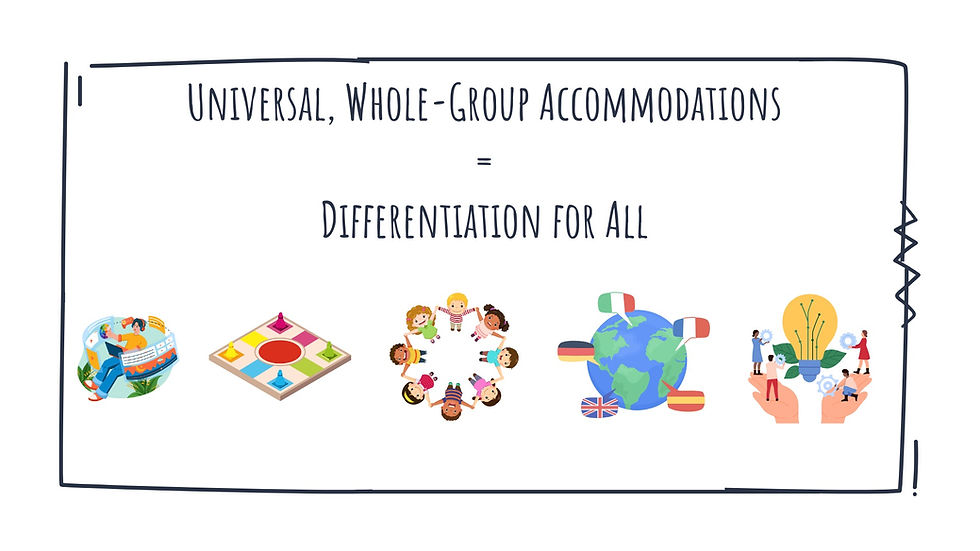
This action study confirmed that universal, whole-group adjustments serve as an effective method of differentiation for all children. When instructors plan classes that include built-in aids, all students have equal access to challenging material. Educators may address a wide range of needs without lowering their standards by combining culturally responsive teaching with technology. This method not only increases participation but also creates a welcoming classroom environment where all students feel heard and encouraged. In the end, every student can not only learn rigorously, but they can also do it.
Comments